Site tour
The Turtle Canyons cruise
Boat and snorkel
- Length2 hours
- In the water1.5 hours at Turtle Canyon
- Pricefrom $89
Your own checklist
Fast answer
Swimming with turtles in Waikiki means sharing the water at a distance of at least 10 feet, never touching, feeding or chasing a turtle.
The rules in brief
Prep list · 11 items
Tick off each point as you complete it. This device keeps your progress.
0 / 11 ready
All set. Pick your Turtle Canyon trip, and the rest is settled.
Secure your spotHonu are protected by federal and Hawaii law. Here is the distance to keep, what breaking the rules has cost real visitors, and how a boat snorkel fits inside the rules.
Editorial team, turtlesnorkelwaikiki.com · Updated November 24, 2026 · A 7 min read
Quick look
The honest answer to the question people type into a search box is that you swim near turtles, never with them. NOAA Fisheries asks people not to swim alongside, ride, stroke or otherwise interact with wild sea turtles.1 Its wider statement goes further and says the agency does not support attempts to swim with, pet, touch or provoke a reaction from the animals, which is a position about the whole activity and not only about riding a shell.6
Behind that guidance sits a statute. Every sea turtle found in the United States is listed under the Endangered Species Act, and under that law it is a crime to harass, hurt, keep or kill a turtle, or to take its eggs or hatchlings.3 Hawaii adds its own layer: the state wildlife agency says all sea turtles in Hawaii are also protected by Hawaii Revised Statutes Chapter 195D and by the administrative rules numbered 13-124.7 Federal and state law therefore run side by side.
Can you swim with sea turtles in Hawaii on a tour, then? You can share the water with them, and that is exactly what a turtle snorkel sells. What no operator can lawfully sell is contact. The rest of this page turns the official wording into practical habits: how far to stay, what to do when a turtle makes the choice for you, what a mistake has cost other visitors and what to ask before you book.
Who sets what
| Rule | Who sets it | What it asks |
|---|---|---|
| Touch and feed | NOAA Fisheries | Never feed or touch sea turtles, because it changes their natural behavior.17 |
| Harassment | Endangered Species Act | Harassing, hurting, keeping or killing a turtle, or taking its eggs or hatchlings, is a crime.3 |
| Viewing distance | NOAA, for Hawaii | At least 10 feet, ashore or afloat.2 |
| Dive flag | State boating division | Snorkelers surface no more than 100 feet from the flag.18 |
| Sunscreen | State legislature | Two sunscreen chemicals left the shelves from 2021 unless prescribed.11 |
| Corals | NOAA Fisheries | Do not touch, kick or stand on the corals.19 |
Each row names the body that wrote the rule; read the sources before you rely on a figure, and treat the Hawaii distance as a minimum.
NOAA's Hawaii guidance is specific. For sea turtles in Hawaii the recommended viewing distance is at least 10 feet, whether the animal is on a beach or in the sea.2 A NOAA enforcement story repeats the same figure and asks the public to view turtles responsibly from that distance.12 That distance is a floor and not a target: the point of the number is that you never have to guess how close is too close. In practice that means a clear gap of open water between you and the animal, so judge it by eye and always err toward more.
The agency also publishes a national guideline, and it is larger. For turtles in the water or nesting on beaches it asks people to remain at least 50 yards away, and for boats it lists the same 50 yards from sea turtles.13,14 The two figures do not contradict each other as long as you read them as labelled: the Hawaii-specific advice is the one aimed at beach and snorkel viewing, and the national guideline is the wider default.
Why does distance matter to the animal and not just to the rulebook? NOAA's sea turtle recovery coordinator says that when people keep at least 10 feet, the animals' resting and feeding habits barely change.15 That sentence is the practical test. If a turtle stops feeding, turns away or changes course because of you, you are too close, whatever the tape measure says.
Distances in the guidance
Fines are not a theory. Two visitors from the mainland shared a photo in which they held a green sea turtle on a Hawaii Island beach and later paid $750 for harassing the animal.4 A visitor who touched a monk seal and harassed a sea turtle on Kauai paid a $1,500 summary settlement.21 Those were settlements for single incidents, and NOAA is plain that they are not the ceiling.
For a violation of the Endangered Species Act, NOAA says civil penalties can exceed $50,000, and criminal penalties can include fines of up to $100,000 and imprisonment of up to one year, depending on the severity.5 Nobody on a Waikiki snorkel cruise is likely to meet those numbers, but they show how the agency regards the offense. Treat them as a reason to keep the camera at arm's length and your hands to yourself.
The detection route is worth knowing as well. NOAA's Pacific Islands staff have closely monitored social media for possible violations, and in the Kauai case an officer used the visitor's own videos to identify him.20 The agency adds that most violators are not out to hurt wildlife; they are visitors chasing a close-up photo.22 So the rule for a camera is simple: zoom in, never move in.
Pick your habit
Tap the situation and the rule that covers it sits right beside it.
If I want to touch a turtle
Do not, ever
NOAA says not to pet, touch or attempt to interact with sea turtles in the wild.1
If A turtle swims right up to me
Stop and let it pass
NOAA's coordinator says behavior changes little when people keep at least 10 feet.15
If I want a photo to share
Zoom, do not approach
NOAA has pursued visitors identified from their own social media posts.20
If I am a weak swimmer
Choose a swim step
One boat tour lets non-swimmers sit with their feet in the water.
If My sunscreen is from home
Check the label
Shops in Hawaii cannot sell the two banned chemicals without a prescription.11
If I am bringing a child
Keep an adult beside them
Every minor on the site tour needs an adult with them.
Trips under the same rules
Site tour
Boat and snorkel
Boat tour
Searches for turtles
Shore
Magic Island Lagoon
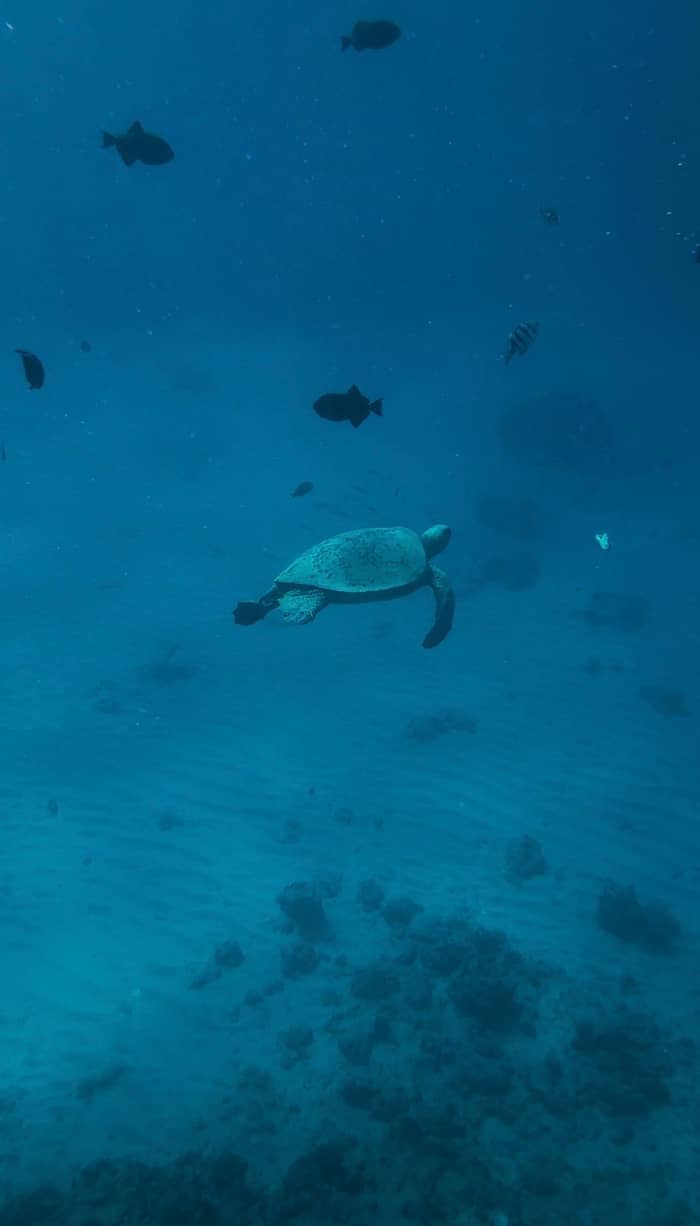
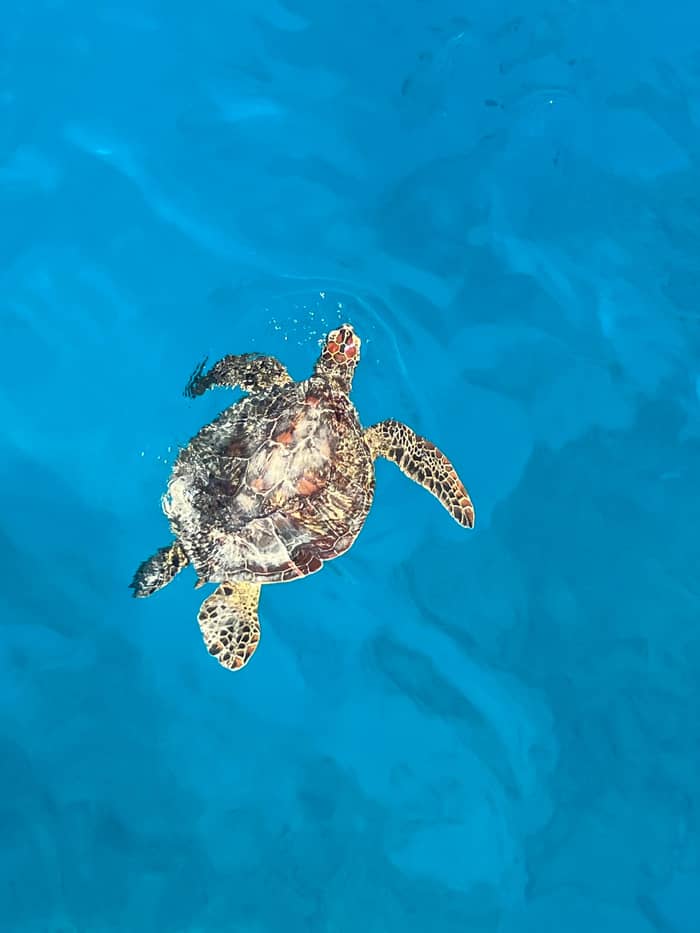
The Turtle Canyons cruise sold on this site is a 2 hour excursion from Kewalo Basin: a 15 minute briefing and cruise, then 1.5 hours of snorkeling at Turtle Canyon, then a 15 minute cruise back. A certified lifeguard supervises the snorkeling, guests are free to climb back aboard when they wish, and a short lesson on the equipment is given on site. The structure of the trip, with a briefing before the water and a fixed block of time on the reef, is what turns a wildlife encounter into a managed one.
The listing never promises contact, and every listing deserves the same reading. One other Waikiki listing warns that no sighting of marine life, turtles among it, can be promised, and that its tours run only when the weather permits. A third offers a free next tour if no turtle is seen. A guarantee is a statement about sightings, never about touching, and a good briefing tells you which behavior ends your swim.
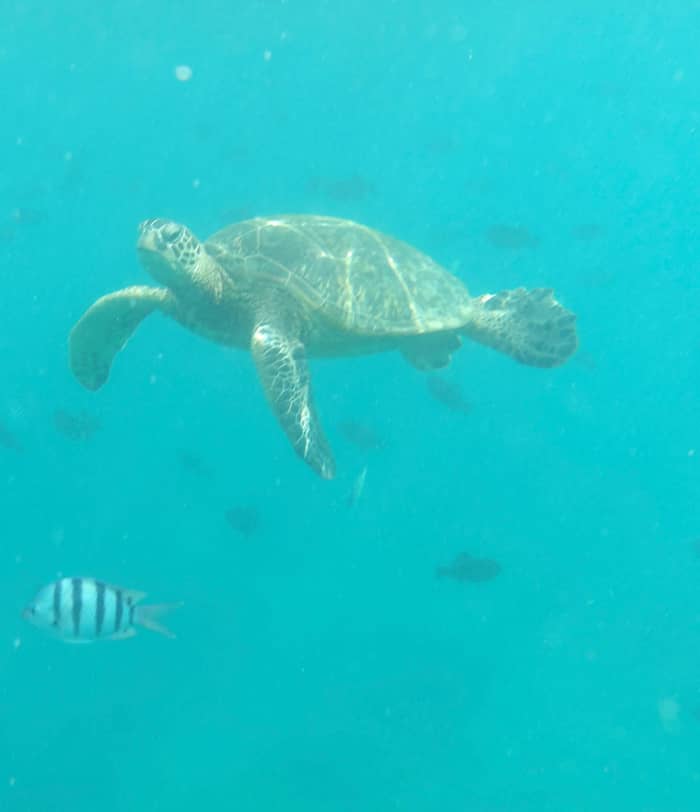
Turtles gather at reefs that NOAA's sanctuary describes as turtle cleaning stations, a kind of reef spot that green turtles visit again and again for a clean-up.24 That helps explain why a snorkeler can see a turtle holding still at a spot like Turtle Canyon, but it does not change your part of the arrangement. A turtle at rest is the clearest signal in the water: float, watch and let the animal decide whether the encounter continues. The same rules apply to sea turtles in Waikiki as anywhere else in the state.
Price the trip
Tell us how many are coming and every cruise below shows its total from the listed starting price.
Weigh up 3 options
Tell us how many are coming and every cruise below shows its total from the listed starting price.
≈
View≈
View≈
ViewConverted at the ECB reference rate, from-prices as listed by GetYourGuide. The precise amount is shown when you book.
How protection grew
Early 1900s
The state aquatic agency records that by the 1900s a green turtle could be bought at any Honolulu market or restaurant.8
1978
Hunting green sea turtles officially became prohibited in 1978, when they were designated under the Endangered Species Act.9
Today
NOAA says honu nesting statewide is growing by 3 to 5 percent per year, though the species remains threatened.10
2021
The act that ended ordinary sales of two reef-harming sunscreen chemicals began on January 1, 2021.11
In the water
The distance NOAA recommends in Hawaii is at least 10 feet, and touching is advised against.2,1
Turtles feed on nearshore coral reefs, which the state's aquatic resources agency calls key foraging habitat for green sea turtles.25 Looking after the reef is therefore part of looking after them. NOAA asks snorkelers and divers to be careful not to touch, kick or stand on corals, and it warns that feeding or touching sea turtles alters their natural behavior.19,17
Sunscreen is the item most visitors forget. The state's sunscreen act took effect on January 1, 2021: from then on, shops in Hawaii cannot sell or distribute lotion that contains oxybenzone or octinoxate unless a prescription is involved.11 The legislature wrote that elevated levels of both chemicals had been detected at popular swimming beaches, Waikiki beach on Oahu among them.26 Buy lotion in Hawaii, or check the label of what you bring for those two ingredients.
State boating law adds a snorkel rule of its own: any activity in the State's navigable waters in which a person breaks the surface and submerges out of sight requires a dive flag, and snorkelers may not surface more than 100 feet from the diver's flag.27,18 A group may share one flag if every member stays within 100 feet of it.28 Staying near the guide on a cruise is therefore also following the law.
Video
Nature on PBS on YouTube · The video only starts loading on your tap.
Never feed or attempt to feed or touch sea turtles as it changes their natural behavior and may make them more susceptible to harm.
Children are welcome on the site tour as long as an adult goes with them, because the record requires every minor to travel with an adult. The best way to prepare a child is a rule they can repeat: look with your eyes, hands tucked in, and wait for the turtle to swim off first. A child who has practiced that on a bath toy is more reliable than one who has been lectured in the boat, and a child who knows the rule will also remind you of it.
A turtle sometimes closes the gap by itself, and that is the moment the rules are written for. Stop kicking, tuck your arms in and let the animal pass, then drift back until you are clear. Do not follow, do not dive down to meet it and do not block its way up to breathe. The distance advice is a promise about your behavior, not about the turtle's. Practice that pause in shallow water if you are nervous: it costs nothing and makes the real moment calm.
If you see an injured, entangled or dead turtle, report it rather than trying to help. NOAA lists (888) 256-9840 as the statewide Marine Wildlife Hotline for that purpose, and tour crews know the number as well.23 Honu are recovering, with nesting growing by 3 to 5 percent per year across the islands, but they remain a threatened population and each careful swimmer is part of that recovery.10 Share the hotline number with your group before you board, so nobody has to look it up in the water.
FAQ
Keep your hands in, do not chase or follow it and back away until you have the clearance NOAA recommends.2
Hawaii stopped retail sales of lotions with those two ingredients, absent a prescription, from January 1, 2021.11
One listing says no sighting can be promised, while another offers a free next tour if no turtle is seen, so read the listing you book.
NOAA lists (888) 256-9840 as the statewide number for an injured or dead sea turtle.23
Sources
Planning a turtle snorkel off Waikiki? Ask a real person here.